The Marketing Strategy Behind India's Quick Commerce Revolution
Industry & Competitive Context
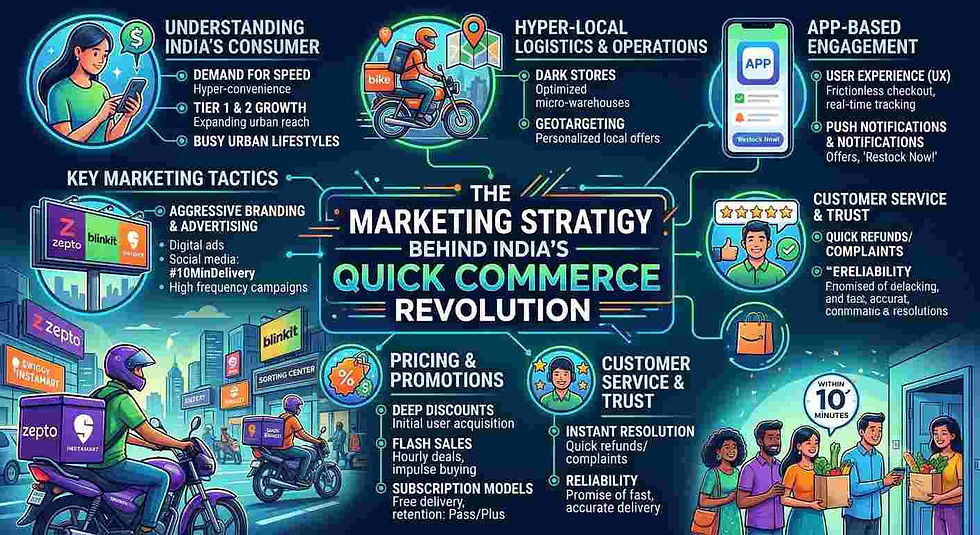
India’s quick commerce (q-commerce) category emerged as a distinct retail format between 2021 and 2022, built around delivery windows of roughly 10 to 20 minutes for groceries and daily essentials, fulfilled through a network of small, localized fulfillment centers known as “dark stores” rather than traditional retail outlets or large warehouses. The category grew out of two converging developments: the pandemic-driven normalization of online grocery ordering, and the entry of well-funded startups willing to underwrite the cost of hyperlocal, inventory-led fulfillment at scale.
The competitive set that defined the category includes Blinkit (originally Grofers, founded in December 2013 by Albinder Dhindsa and Saurabh Kumar, and rebranded to Blinkit in December 2021), Zepto (founded in 2021 by Aadit Palicha and Kaivalya Vohra, after an earlier venture called KiranaKart), Swiggy Instamart (launched by Swiggy in August 2020), and BigBasket’s BBnow, a quick commerce format launched by the Tata-owned grocery platform in 2022. Amazon and Flipkart have also entered adjacent fast-delivery formats in subsequent years, reflecting the category’s pull on India’s broader e-commerce incumbents.
By 2022, Blinkit was acquired in full by Zomato (later renamed Eternal Limited) in an all-stock deal valuing Blinkit at approximately US$568 million; the deal was announced on 24 June 2022 and completed on 10 August 2022, following an earlier minority stake purchase by Zomato in June 2021. This consolidation signaled that quick commerce was no longer a standalone niche but a strategic extension of India’s existing food-delivery and e-commerce infrastructure. Swiggy’s own path followed a similar logic: Instamart was built as an in-house vertical rather than an acquisition, and it became a core growth pillar cited in Swiggy’s November 2024 initial public offering, which priced shares at ₹390 and valued the company at approximately US$11.3 billion.
Industry estimates reported in the trade press (including a projection attributed to brokerage Equirus) put India’s quick commerce market at approximately ₹1.08 lakh crore by 2026, with year-on-year growth cited at around 40%. While exact market-sizing figures vary by research provider and methodology, the directional signal rapid, multi-year expansion from a near-zero base in 2020 is consistent across public reporting and corporate disclosures.
Brand Situation Prior to the Category’s Emergence
Before quick commerce existed as a format, Indian consumers relied on a mix of neighborhood “kirana” stores for immediate needs and scheduled online grocery delivery (led by players such as BigBasket and Grofers in their earlier avatars) for planned, larger basket purchases. Scheduled e-grocery typically promised delivery within hours or on a next-day basis. This left a gap for consumers who needed a small number of items a forgotten ingredient, a daily essential, a last-minute purchase immediately, a need traditionally served only by the physical kirana store down the street.
Grofers’ own pre-2021 positioning was that of a conventional online grocery platform competing on selection and price within the scheduled-delivery model. Its 2021 rebrand to Blinkit, accompanied by the introduction of 10-minute delivery in 12 large cities that August, marked an explicit strategic pivot from “online grocery store” to “instant commerce utility.” Zepto, by contrast, was built from inception around the dark-store, 10-minute model, after its founders’ earlier kirana-partnership concept (KiranaKart) failed to gain traction a documented example of a startup abandoning an asset-light marketplace model in favor of an inventory-led, company-operated fulfillment network.
Strategic Objective
Across the category, the publicly observable strategic objective was consistent: to redefine the consumer’s basic expectation of delivery speed for everyday essentials, and in doing so, to capture the recurring, high-frequency occasions that had previously defaulted to the neighborhood kirana store. This was not simply a logistics upgrade to existing e-grocery; it was a repositioning of digital commerce itself, from a planned, deliberate activity to an impulsive, on-demand one comparable in immediacy to ordering food.
For Zomato, the strategic rationale for acquiring Blinkit was to extend its logistics and rider network already built for food delivery into adjacent grocery and essentials categories, using a shared delivery fleet and customer base. For Swiggy, launching Instamart in-house served the same purpose: leveraging an existing base of app users and a delivery workforce to enter a second, structurally similar category. For BigBasket, the 2022 launch of BBnow represented a defensive and offensive repositioning an attempt by an established, scheduled-delivery grocery player to retrofit speed into its existing supply chain and retain share against newer, speed-first entrants.
Campaign Architecture & Execution
Public information on the specific advertising campaigns run by these companies is limited largely to product launches, city expansion announcements, and category-extension moves rather than disclosed creative or media campaign details. What is documented is the sequencing of execution, which itself reveals the marketing logic of the category.
Blinkit’s documented execution began with the rebrand from Grofers in December 2021, paired with the 10-minute delivery promise introduced a few months earlier across 12 cities using the brand name change itself as a marketing event to reset consumer perception around speed. Following its 2022 acquisition by Zomato, Blinkit’s expansion was reported through city-count disclosures: by March 2025, the company was reported (via a JP Morgan-cited analysis) to be operating in 153 Indian cities. This steady, publicly tracked geographic expansion functioned as an ongoing proof point of scale and reliability, reinforcing the core “speed and availability” promise with each new market entry.
Zepto’s execution was defined by an unusually fast and heavily publicized funding cadence, which itself functioned as a marketing and credibility signal in a category where consumer and investor trust in a new entrant’s staying power mattered as much as advertising spend. Its valuation moved from approximately $225 million in October 2021 to $570 million in December 2021, $900 million in May 2022, $1.4 billion in August 2023 (the round that conferred unicorn status), $3.6 billion in June 2024, $5 billion in August 2024, and approximately $7 billion in a round reported in October 2025. Each funding milestone was covered extensively in Indian business media, generating recurring brand visibility independent of paid advertising. Operationally, Zepto was reported to run over 250 dark stores across ten metropolitan areas as of August 2024, and it extended its model into adjacent formats, including a food-delivery vertical called Zepto Cafe, launched in April 2022, that applied the same 10-minute promise to prepared food.
BigBasket’s execution under Tata ownership took a different tack: rather than compete purely on speed, it combined its established “mega commerce” (bulk, scheduled) business with the BBnow quick-commerce format, and later extended the instant-delivery promise into new categories, including a reported 10-minute delivery of the iPhone 16 and plans (reported in trade press) to introduce 10-minute food delivery by the end of FY26. This category-extension approach stretching the “10-minute” promise beyond groceries into electronics and prepared food was mirrored across the competitive set and represents a documented pattern: the core marketing asset in this category was not a single campaign but the delivery-time claim itself, repeatedly re-applied to new product categories to sustain novelty and media coverage.
Swiggy Instamart’s execution was closely tied to its parent company’s public market narrative. Ahead of and following Swiggy’s November 2024 IPO, Instamart’s dark-store expansion was cited as a specific use of IPO proceeds, with company disclosures and press coverage noting continued growth in store count for instance, an expansion to 127 cities and 41 new dark stores reported in July 2025. This reflects a marketing strategy executed substantially through investor communications and capital-allocation disclosures as much as through consumer-facing advertising, consistent with Instamart’s position as a growth vertical inside a newly listed company under public shareholder scrutiny.
Positioning & Consumer Insight
The consumer insight underlying the category, as evidenced by the companies’ own strategic choices (the shift from scheduled to instant delivery, the shift from asset-light kirana partnerships to owned dark stores, and the extension of delivery speed into non-grocery categories) was that immediacy, not merely price or assortment, had become the primary axis of competition for everyday purchases in urban India. Each major player positioned itself around a close variant of the same core promise: delivery in approximately 10 to 20 minutes, communicated as a direct comparison point against both traditional e-grocery (measured in hours) and the physical kirana store (measured in the time to walk there and back).
This is a documented repositioning strategy rather than an inferred one: Blinkit’s own rebrand announcement explicitly tied the new name to the 10-minute delivery proposition, and Zepto’s founders have been publicly quoted (including in response to public criticism from businessman Anand Mahindra in 2022) defending the operational feasibility of the model, noting that fulfilling 10-minute delivery windows required average vehicle speeds under 15 km/h given the density of dark stores relative to customers. This public exchange itself became a documented instance of the category’s positioning being defended and reinforced through earned media.
Media & Channel Strategy
Verified public information on formal advertising media mix (television, digital, out-of-home spend splits) for these companies is not available in company disclosures, annual reports, or credible news coverage reviewed for this case. No verified public information is available on the specific paid media allocation, creative strategy, or agency partnerships used by Blinkit, Zepto, Swiggy Instamart, or BigBasket for quick commerce marketing campaigns.
What is documented is that a substantial share of brand visibility for these companies was generated through non-traditional channels: funding announcements and valuation milestones (particularly for Zepto), city and dark-store expansion disclosures (for Blinkit and Instamart), IPO-related investor communications (for Swiggy/Instamart and, by extension, Eternal/Blinkit), and category-extension product launches covered as business news rather than as advertising (such as BigBasket’s 10-minute iPhone delivery). This pattern suggests that, in the quick commerce category, financial and operational milestones functioned as a primary, verifiable channel of marketing communication, operating alongside and in the public record, more documented than conventional advertising.
Business & Brand Outcomes
Documented business outcomes are strongest at the corporate level rather than the brand-campaign level. Blinkit reported revenue of ₹5,206 crore (approximately US$540 million) for FY25, per figures disclosed in connection with its parent company Eternal Limited, and was reported to be operating in 153 cities as of March 2025. Zepto reached unicorn status (a valuation of US$1 billion or more) in August 2023 and was valued at approximately US$7 billion in a funding round reported in October 2025, having raised more than US$1.5 billion in total funding since its founding, including over US$1 billion raised during 2024 alone. Swiggy’s parent company completed its IPO in November 2024 at a valuation of approximately US$11.3 billion, with Instamart explicitly cited as a growth driver and a stated use of IPO proceeds for continued dark-store expansion; Swiggy’s company-wide FY25 revenue was reported at ₹163.33 billion, alongside an operating loss of ₹19.1 billion, though these figures are not broken out specifically for Instamart in public disclosures.
Trade press coverage citing brokerage research (including ICICI Securities) indicated that sector-wide quick commerce growth moderated to under 20% sequentially in a reported Q1 of FY26, with Blinkit’s sequential gross order value growth cited at approximately 25% and Instamart’s at approximately 22% for the same period, while Zepto’s growth was reported to have plateaued as the company reportedly prioritized reducing cash burn. These figures are attributed to brokerage analysis reported in the press rather than to direct company disclosure, and exact absolute order volumes, profitability, and city-level performance for individual players beyond these cited figures are not verified in public company reporting reviewed for this case.
Strategic Implications
The documented record of India’s quick commerce category offers several strategic lessons that can be analyzed without resorting to undisclosed internal metrics. First, the category illustrates how a single, simply communicated performance promise — delivery time — can function as a complete repositioning strategy, sufficient to justify a corporate rebrand (Grofers to Blinkit) and to anchor an entirely new venture (Zepto) from inception, without requiring an elaborate multi-attribute value proposition.
Second, the acquisition of Blinkit by Zomato, and the in-house incubation of Instamart by Swiggy, demonstrate two distinct but equally documented paths to category entry for an incumbent platform business: buy an existing specialist to inherit its dark-store network and operational learning, or build the capability internally by redeploying an existing delivery fleet and customer base into a new transaction category. Both paths relied on an existing logistics and demand asset as the entry wedge, rather than building quick commerce from a standing start.
Third, the heavy public reliance on funding-round disclosures, IPO narratives, and city/store-count expansion announcements as documented marketing touchpoints suggests that in a capital-intensive, infrastructure-led category such as quick commerce, financial market communication and operational-scale disclosure can substitute for, or substantially complement, traditional brand advertising in building consumer and investor confidence simultaneously.
Fourth, the extension of the “10-minute” promise beyond groceries into categories such as electronics (BigBasket’s iPhone delivery) and prepared food (Zepto Cafe) indicates a documented pattern of brand-promise elasticity, where a single, well-established performance claim becomes the organizing principle for category diversification, rather than each new category requiring a distinct value proposition.
Finally, the moderation in sector-wide growth rates reported by brokerage analysts in Q1 of FY26, alongside reports that one major player prioritized reducing cash burn over continued growth, indicates that the category may be entering a phase where the original speed-led positioning must coexist with demonstrated financial discipline a transition that is itself a documented, ongoing strategic challenge for an industry built initially on aggressive, loss-funded expansion.


Comments