Social platforms are turning attention into transactions
Social media began as a place to share updates, follow friends, and consume entertainment. It is increasingly becoming a place where people discover products, evaluate them through creators and communities, and complete purchases without leaving the app. The shift is often described as “social commerce”: platforms are compressing discovery, influence, and checkout into a single, high-velocity journey. The commercial logic is simple—where attention goes, transactions can follow.
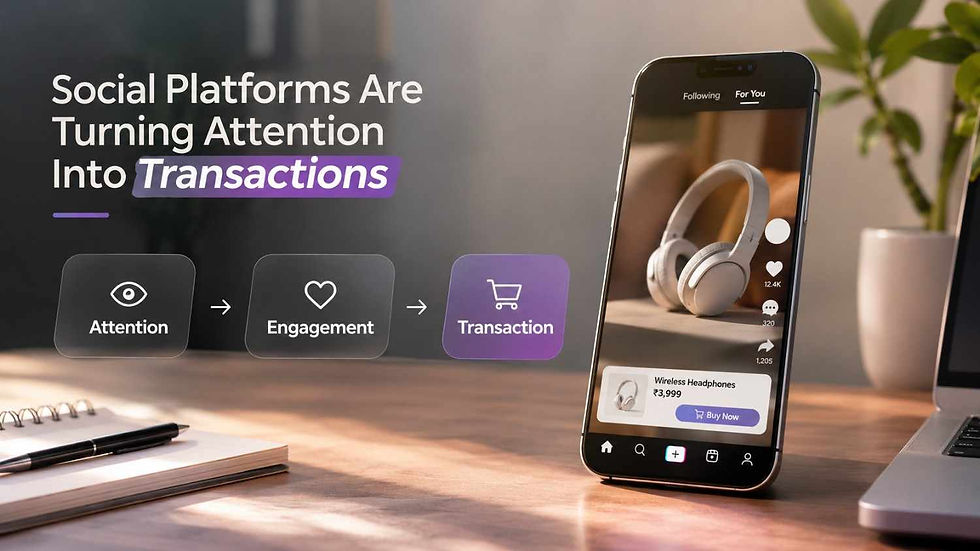
This does not mean every scroll ends in a sale, nor that advertising has disappeared. Rather, platforms are building more direct paths from a video, livestream, recommendation, or conversation to a product page, booking, subscription, or checkout. For brands, creators, and retailers, the important change is that social platforms are no longer only top-of-funnel media channels; they increasingly want to own more of the purchase journey itself.
From discovery to checkout
Traditional e-commerce usually separated attention from action. A consumer might see an advertisement on Instagram or TikTok, search for the product later, compare prices on a marketplace, and finally buy from a retailer’s website. Social commerce shortens that path by embedding product information, creator endorsements, reviews, and checkout options directly inside the social experience.
Shopify defines social commerce as the use of social platforms to promote and sell products or services, including interactions that can lead to a completed transaction through native in-app checkout or by sending audiences to an external store. The key distinction is that commerce is becoming native to the platform rather than merely advertised on it.
Retail Economics describes this as platforms “collapsing the path to purchase,” moving consumers from discovery to checkout without leaving the app. Its survey of 2,000 UK consumers found that 55% had purchased directly through a social platform, which the report presents as evidence that social commerce has moved beyond a niche behaviour and into mainstream retail.
The practical result is that the feed can function like a storefront. A user watches a creator demonstrate a product, sees a tagged item or shoppable link, asks questions in comments or messages, and may be able to buy immediately. The platform benefits because it retains the user, the data, and potentially a share of the transaction. The brand benefits from reduced friction, while the creator may receive commissions, advertising revenue, or direct-payment opportunities.
Why attention is valuable
Attention has always been commercially important, but its value rises when it can be converted quickly into intent. Short-form video, livestreams, creator recommendations, and community discussions are particularly effective at creating context around a product. Rather than presenting a static advertisement, a creator can show how an item is used, answer objections, demonstrate results, and respond to audience questions in real time.
A Meta-Ipsos study cited by Business Standard surveyed more than 4,000 respondents across 23 Indian cities and found that 97% of users watch videos on social platforms daily. The report also noted that Gen Z pays up to 34% less attention to advertisements on conventional social platforms than Millennials, while immersive and creator-native formats continue to drive engagement and measurable business outcomes. That combination—high video consumption but lower tolerance for conventional ads—helps explain why platforms are investing in commerce features rather than relying solely on interruptive advertising.
Billo’s 2026 social commerce trends analysis, also cited by Business Standard, found that social platforms have become a primary entry point for product discovery. Short-form video, user-generated content, and creator-led content shape purchase decisions before checkout, while entertainment and live shopping reduce the distance between viewing and buying.
This is why the phrase “the scroll is turning into the storefront” is more than a marketing slogan. Platforms are trying to make the moment of interest—the instant a person sees a product in context—the moment of purchase.
TikTok’s commerce push
TikTok is one of the clearest examples of this shift. In October 2026, it announced AI-powered advertiser tools including Buy Direct, which lets users check out from a brand directly in the For You feed; Shopping Assistant, a conversational AI tool intended to answer product questions and help with purchases; and Agentic Leads, which qualifies prospective customers through guided conversations in DMs and advertiser lead forms. TikTok also opened its Ad Network, extending campaigns across nearly 400,000 apps, to US advertisers.
TikTok’s own October 2026 update framed the strategy as “turning discovery into action.” It said it was building agentic commerce experiences with partners including Salesforce, Shopify, Shoplazza, and Stripe, and highlighted TikTok GO, an in-app travel-booking feature that lets US users discover and book hotels, attractions, and experiences through videos, search, and location pages.
The broader point is that TikTok is not merely selling ad placements. It is building infrastructure that turns content into a commercial interface: product discovery, AI-assisted consideration, lead generation, checkout, and even travel booking can occur within one ecosystem. That makes the platform more valuable to advertisers and merchants, but it also increases its role in shaping what consumers see, consider, and buy.
Creators become sales channels
Creators sit at the centre of this transformation. They are no longer only publishers of sponsored posts; they can become storefronts, affiliates, live sellers, and direct-to-fan businesses. Their advantage is trust and context. A recommendation from a creator can feel more personal than a display ad, especially when the creator has expertise, a consistent niche, or an engaged community.
Cameo’s partnership with TikTok illustrates the direct-monetization model. Creators with at least 50,000 followers can embed booking links for personalized videos directly in posts, allowing fans to buy in the same moment they are watching. Cameo’s chief executive, Steven Galanis, argued that direct-to-fan transactions are becoming a primary way for digital talent to earn a living, and that enabling purchases without leaving the platform changes the creator economy.
This matters because creators have long faced a gap between audience size and income. Viral reach does not automatically produce revenue, particularly when outbound links reduce engagement or direct users away from the platform. Embedding commerce into posts reduces that friction. It also gives platforms a stronger reason to support creators: creators generate the attention, and the platform can monetize the transaction that follows.
The risks and limits
The opportunities are substantial, but the model is not frictionless. Consumers may be wary of impulsive purchases, opaque pricing, misleading product claims, counterfeit goods, or difficult returns. The more seamlessly a platform turns attention into a transaction, the more important consumer protection becomes.
Regulation is also becoming more prominent. Finn Partners reported that, in October 2026, a New Mexico judge ordered Meta to pay $25 billion following a September jury finding of more than 43 million violations of state consumer-protection law connected to deceptive statements about privacy on Facebook and the Cambridge Analytica data scandal. Whatever one concludes about that particular case, it underscores a wider reality: platforms that monetize attention through data, targeting, and commerce face growing scrutiny over privacy, manipulation, and consumer harm.
There is also a strategic tension for brands. Social commerce can generate demand across many touchpoints, but platforms that centralize transactions may also concentrate power over customer relationships, data, fees, and fulfillment. Shopify notes that social shopping can create demand across multiple channels while social commerce centralizes transactions inside “walled gardens.” Brands therefore need to balance the convenience of in-app selling with the risk of becoming overly dependent on a single platform’s algorithms and rules.
What comes next
The direction of travel is clear: social platforms are building systems that turn attention into measurable commercial outcomes. TikTok is embedding checkout, AI shopping assistance, and travel booking into its feed. LinkedIn is testing creator revenue sharing and paid Advice Sessions. Instagram is testing longer videos and companion tools designed to keep audiences engaged within its ecosystem.
For consumers, the experience may become more convenient: see something useful, learn about it quickly, and buy it without switching apps. For businesses, the opportunity is to meet demand at the point of discovery. But the winners will not necessarily be those with the biggest followings. They will be the brands and creators that combine compelling content with trustworthy products, transparent pricing, responsive service, and a clear reason for a customer to act.
Attention is no longer the end goal. The platforms that succeed will be those able to convert it responsibly into genuine value—for shoppers, creators, merchants, and themselves.
Sources
Retail Economics — The billion-dollar battleground of social commerce: https://www.retaileconomics.co.uk/retail-insights/thought-leadership-reports/unbox-the-billion-dollar-battleground-of-social-commerce
Business Standard — Ads to algos: Are IG, Snapchat and YT becoming new digital shopping malls?: https://www.business-standard.com/technology/tech-news/ads-to-algos-are-ig-snapchat-and-yt-becoming-new-digital-shopping-malls-126060500718_1.html
Shopify — Social Commerce Trends for 2026: What’s Changing: https://www.shopify.com/enterprise/blog/social-commerce-trends?ref_type=adv
Finn Partners — November social media updates: Platforms turn attention into transactions: https://www.finnpartners.com/news-insights/boom-scroll-november-2026-social-media-updates/
TikTok — TikTok Updates, October 2026: https://releasebot.io/updates/tiktok/tiktok
BuzzFeed Business — Steven Galanis: TikTok And Cameo Are Closing The Gap: https://www.buzzfeed.com/business-news/tiktok-cameo-direct-fan-monetization-steven-galanis
Shopify — What Is Social Shopping and Why Does It Matter for Ecommerce?: https://www.shopline.com/blog/social-shopping-for-ecommerce


Comments