The Next Billion Consumers: Marketing Opportunities Beyond Metro Cities
Industry & Competitive Context
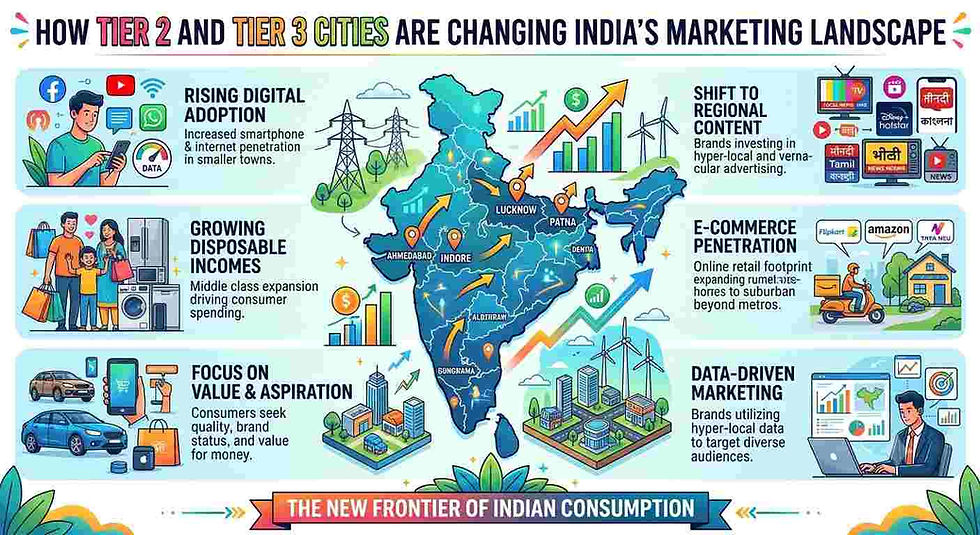
India’s internet base has moved decisively past its metro-city origins. According to the Internet in India Report 2024, published jointly by the Internet and Mobile Association of India (IAMAI) and Kantar, the country had 886 million active internet users in 2024, an 8% year-on-year increase, with the user base projected to cross 900 million in 2025. Of this base, 488 million users, or 55%, were located in rural India, and rural internet adoption was growing at roughly double the rate of urban adoption. The same report found that 98% of users accessed content in Indic languages, that women constituted 47% of all internet users (the highest share recorded to date), and that while urban users led in digital payments and net commerce, rural users led in OTT video, music streaming, and social media use. Mobile remained the dominant access device across both geographies.
This shift created a structural opportunity: a consumer base large enough, and now digitally reachable enough, to reward companies that could profitably serve Tier 2, Tier 3, and Tier 4 towns rather than treating them as an afterthought to metro operations. The Indian e-commerce sector responded with a distinct category often described as “value commerce,” positioned against the premium, brand-led commerce associated with the metro-first platforms. Three players came to define this category. Meesho, founded in 2015, built its entire model around non-metro and low-income consumers from inception. Flipkart launched Shopsy in mid-2021 specifically to reach “tens of thousands of low-income shoppers in Tier 2-3 towns” through a zero-commission marketplace model, according to statements made by Flipkart senior vice-president Adarsh Menon and reported in the business press. Amazon followed in April 2024 with Amazon Bazaar, a marketplace offering affordable, largely unbranded products across lifestyle and home categories. By the mid-2020s, Meesho, Shopsy, and Amazon Bazaar were competing directly for the same cohort of first-time and value-conscious digital shoppers in smaller Indian towns, each disclosing its own non-metro traction figures through press statements and media interviews, though these figures use different definitions and are not independently audited or directly comparable across companies.

Brand Situation Prior to Campaign
Meesho did not begin as the platform it is known as today. According to the company’s own published account, Vidit Aatrey and Sanjeev Barnwal founded the venture in July 2015 under the name Fashnear, initially envisioned as a hyperlocal fashion platform modelled on food and grocery delivery: local stores in Bengaluru’s Koramangala and HSR Layout neighbourhoods would list products, and customers would receive several items at home, keep what they liked, and return the rest. This model did not work, in the company’s account, because the offline stores involved were primarily interested in running end-of-season clearance sales rather than ongoing hyperlocal retail, and customers cared more about discounts than about local sourcing.
The pivot came from an unplanned insight: the founders observed a shop owner in Koramangala selling products through WhatsApp and Facebook groups. This led to a new product, “Meri Shop” (shortened to Meesho), which let small shopkeepers move their businesses online with auto-stocking and inventory management; roughly 10,000 shops signed up within about six months of this version’s launch, per the company. In running this product, the founders discovered that the most active sellers on the platform were not shopkeepers at all but women reselling products from home, without holding any inventory themselves they would curate photos of products from suppliers and only place an order with the supplier once a customer had committed to buying. Meesho restructured itself around this behaviour, positioning the company as a bridge connecting suppliers directly to a distributed network of individual resellers, and launched the “Meesho Supply” app with cash-on-delivery, returns handling, and seller support built in. The two apps ran in parallel for roughly nine months before the company began charging commission and consolidated around Meesho Supply, which became the Meesho app used today. This origin matters to the case because it means Meesho’s non-metro orientation was not a diversification strategy layered onto an existing metro business, as it was for Flipkart and Amazon; it was the foundational model from which the company never needed to pivot away.
Strategic Objective
Meesho’s publicly stated strategic emphasis, as reflected in its own communications and in industry reporting, has been to scale ecommerce participation among a population segment it internally frames as being outside the reach of traditional branded retail and premium ecommerce consumers in Tier 3 and Tier 4+ towns, with particular attention to women as both resellers and end consumers, and to categories such as fashion, beauty, personal care, and home essentials.
Campaign Architecture & Execution
Rather than a conventional advertising campaign, Meesho’s non-metro market entry and expansion were executed primarily through business-model architecture. The reseller network functioned as a distribution and demand-generation mechanism simultaneously: individual resellers, operating largely through WhatsApp and social messaging within their own local networks, extended Meesho’s reach into towns and neighbourhoods that neither a branded retail outlet nor a conventional digital marketing campaign could cost-effectively penetrate on its own. This structure allowed trust and product discovery to travel through existing social relationships rather than through paid acquisition alone.
The execution is visible most clearly in the company’s periodic sales events, which function as the primary documented instances of coordinated marketing activity. During the company’s Mega Blockbuster Sale in 2025, Meesho reported that shoppers spent close to 117 million hours on the platform, recorded close to 206 crore (2.06 billion) customer visits, saw prepaid transactions rise 57%, recorded over 2 crore (20 million) app downloads during the sale window, and handled 52,000 active users per minute at peak load, which the company attributed in part to AI-driven personalised product feeds. On the supply side, seller participation during the same event grew 57% year-on-year, with growth cited from towns including Warangal, Chhapra, and Cuddapah alongside metro cities; approximately 49,000 new sellers joined the platform, and sellers listed around 4.6 crore (46 million) new products. Category-level growth during the sale was led by office supplies, which rose 97% year-on-year, followed by sports and fitness equipment at 86% and health and wellness essentials at 69%, alongside fashion-led festive categories such as kurtis, jewellery, lipsticks, puja decor items, and children’s ethnic wear. NITI Aayog fellow Badri Narayanan, founder of Infinite Sum Modelling, was quoted in coverage of this sale period observing that Meesho had “carved out dominance in tier 3+ markets, capturing users drawn by affordability and accessibility.”
Separately, in a year-end report covering 2024, Meesho disclosed a 35% year-on-year increase in overall orders across fashion, beauty, personal care, and home essentials, attributing this growth to rising demand from smaller towns, an increase in Gen Z shoppers, and the company’s investment in generative AI capabilities. The company also reported that regions including Ladakh, Uttar Pradesh, and Bihar were among the fastest-growing markets by order volume, with orders from these emerging markets growing over 70% year-on-year, led by beauty, personal care, and home appliance categories.
Positioning & Consumer Insight
Meesho’s positioning rests on an underlying consumer insight documented through its own official statements: that nearly 50% of its user base is drawn from Tier 4-plus towns, with the company citing specific examples including Naidupeta in Andhra Pradesh, Sherghati in Bihar, and Harapanahalli in Karnataka. This figure is a company self-report, and the public reporting on it does not disclose the methodology used to classify these towns or compute the share. The strategic logic embedded in this positioning treats affordability and accessibility, not brand prestige, as the primary value proposition for this consumer segment a direct inversion of the premium positioning strategies typically used by metro-focused retail and ecommerce brands. The reseller model itself embodies a consumer insight about trust: in markets with limited exposure to organised branded retail and in many cases limited comfort transacting with an unfamiliar digital platform directly, a known intermediary frequently a woman in the buyer’s own social or family network lowers the perceived risk of an online purchase in a way that platform-level advertising alone cannot replicate. This is consistent with the broader IAMAI-Kantar finding that women made up 58% of shared-device internet users in rural India, suggesting that household and social-network dynamics play a disproportionately large role in how non-metro consumers, and particularly women, access and trust digital commerce.
Media & Channel Strategy
Verified public information on Meesho’s channel strategy centres on its own mobile application and website as the primary digital storefront, supported by the distributed reseller network operating through peer-to-peer social channels such as WhatsApp. No verified public information is available on Meesho’s use of, or spend across, mass media channels such as television, print, or outdoor advertising, nor on any specific regional-language digital advertising campaign with a disclosed budget or agency partner. What is documented is the scale of app-based engagement during promotional events, as described above, and the company’s own statements attributing growth partly to generative AI-driven personalisation of product feeds and search, which functions as a channel-level mechanism for matching a highly fragmented, non-standardised product catalogue to geographically dispersed, often first-time digital shoppers.
The competitive response from larger, metro-origin platforms offers a useful point of comparison on channel strategy, since it was reported with more platform-level detail. Flipkart’s Shopsy, launched in mid-2021 as a zero-commission marketplace explicitly aimed at Tier 2 and Tier 3 towns, was reported by Flipkart’s own senior vice-president to account for roughly 40% of Flipkart’s new customers within a year of launch, with over 68% of Shopsy’s customers originating from Tier 2-3 cities. Separate industry reporting indicated Shopsy recorded 330 million app downloads over three years and around 70% participation from Tier 2 and Tier 3 towns such as Bhagalpur, Bankura, Kurnool, Nagaon, and Dhule. Amazon’s comparable disclosures showed that during its Great Indian Festival sale period, over 85% of total visits out of 140 crore (1.4 billion) customer visits came from non-metro cities, that non-metro customers accounted for over half of television and large-appliance sales, and that Amazon Bazaar, launched in April 2024, reported a fourfold increase in users, with growth concentrated in Tier 2 and other non-metro cities. These figures are company disclosures reported by business media rather than independently audited statistics, and because each company defines “non-metro,” “Tier 2/3,” and “Tier 4+” differently, and measures different units (visits, downloads, active users, or share of new customers), direct quantitative comparison across Meesho, Shopsy, and Amazon Bazaar is not reliable from publicly available information.
Business & Brand Outcomes
The clearest documented business outcome of Meesho’s non-metro strategy is its path to a public listing. The company, backed by SoftBank, filed confidentially for an initial public offering targeting approximately ₹4,250 crore, later finalising an IPO of approximately ₹5,421 crore (roughly $604 million) that opened for subscription on December 3, 2025, targeting a valuation of approximately $5.6 billion. Investor demand for the offering was reported at approximately $28 billion in bids. Meesho’s listing was widely reported as India’s first major e-commerce IPO. Upon its market debut, reported in business press coverage dated December 10, 2025, the company reached a valuation of approximately $8.8 billion, described in coverage as a “blockbuster debut.”
On brand-level engagement outcomes, the documented sale-event figures described above order growth of 35% in 2024, over 70% order growth from emerging markets such as Ladakh, Uttar Pradesh, and Bihar, nearly 45% to 50% of customers originating from Tier 4-plus towns depending on the period cited, and seller base growth of 57% year-on-year during the 2025 festive sale represent the most consistently documented indicators of the strategy’s traction in non-metro India. No verified public information is available on brand awareness, Net Promoter Score, or other brand-health metrics for Meesho in non-metro markets specifically, as these have not been identified as publicly disclosed by the company.
Strategic Implications
This case illustrates that reaching non-metro consumers in India has, for at least one significant player, depended less on adapting a metro-designed marketing campaign for a new audience and more on building a distribution architecture the reseller network in which trust, discovery, and last-mile reach were handled by distributed individuals embedded in local social networks rather than by centralised brand communication. The comparison with Flipkart’s Shopsy and Amazon Bazaar suggests that metro-origin platforms have been able to achieve substantial non-metro traction by launching dedicated, separately branded, lower-friction marketplace formats rather than by extending their core apps, indicating that platform architecture and commission structure may matter as much as messaging in this market segment. The scale of the underlying opportunity, with rural India comprising 55% of the country’s internet user base and growing at roughly twice the urban rate per the IAMAI-Kantar data, together with the finding that women represent a majority of shared-device users in rural areas, points toward continued strategic emphasis on vernacular-language product experiences, low-bandwidth-friendly design, and socially mediated trust mechanisms as durable, rather than transitional, features of this market not simply a bridge until non-metro consumers come to resemble metro ones.


Comments