The Rise of Answer Engine Optimization and the New Search Battlefield
Industry and Competitive Context
For more than two decades, discoverability on the internet ran through a single chokepoint: the search engine results page, dominated globally by Google. Brands built entire marketing functions search engine optimization (SEO), paid search, content marketing around the logic of ranking among “ten blue links” and earning a click. That logic is now being rewritten by generative artificial intelligence.
In February 2024, Gartner published a widely reported forecast stating that traditional search engine volume would fall 25% by 2026 as consumers shift queries to AI chatbots and virtual agents. The prediction became a reference point across the marketing industry precisely because the shift it described was already visible. Google itself began moving its core product toward AI-generated answers: at Google I/O in May 2024 it introduced “AI Overviews,” an AI-generated summary placed above traditional organic results for a growing share of queries. By October 2024, Google confirmed the feature had expanded to more than 100 countries and territories and was reaching over 1 billion users every month. By Google I/O in May 2025, the company said AI Overviews had expanded further, to more than 200 countries and 40 additional languages.
At the same time, entirely new entrants built their businesses around answering questions directly rather than linking to pages that might contain the answer. OpenAI’s ChatGPT, initially a general-purpose conversational assistant, added a dedicated search function in 2024 and has since become a meaningful discovery surface in its own right. OpenAI disclosed that ChatGPT crossed 100 million users within two months of its public launch, at the time the fastest consumer application adoption in history, and by August 2025 an OpenAI product lead, Nick Turley, stated publicly that the product was on track to reach 700 million weekly active users, alongside more than 1 billion daily queries. OpenAI’s own disclosed revenue grew from roughly $1.3 billion in 2023 to $3.7 billion in 2024, with the company’s chief financial officer projecting revenue of approximately $11 billion by the end of 2025.
A second category of pure-play “answer engines” emerged alongside the incumbents. Perplexity AI, founded in 2022, positioned itself explicitly as an answer engine rather than a search engine, returning synthesized responses with inline citations instead of a ranked list of links. Perplexity’s chief executive, Aravind Srinivas, stated publicly at a Bloomberg technology conference, as reported in June 2025, that the platform was processing approximately 780 million search queries per month as of May 2025, up from a reported single-digit number of queries on its first day of operation in 2022, with month-over-month growth exceeding 20%.
This combination of a declining-traffic forecast from an independent research firm, a billion-user pivot inside the world’s dominant search engine, and the rapid scaling of AI-native challengers defines the competitive context in which a new discipline Answer Engine Optimization (AEO), closely related to what the industry also calls Generative Engine Optimization (GEO) has emerged. The battlefield is no longer only about ranking a webpage. It is about whether a brand is cited, summarized, and recommended inside an AI-generated answer that the user may never click through from.

Brand Situation Prior to the Shift
Before this shift, the operating assumption of digital marketing was stable: a consumer typed a query, received a page of ranked links, and clicked through to a website, where engagement, conversion, and attribution could all be measured against a visit. Marketing organizations built their measurement, content, and SEO infrastructure around that single assumption visibility equaled a link position, and traffic equaled opportunity.
That assumption began to erode as AI-generated answers inserted themselves before the list of links, and as entirely new platforms offered an answer with no link at all. Boston Consulting Group’s 2026 CMO research, based on a survey of 300 chief marketing officers, found that 90% of CMOs agreed that generative AI is already reshaping how consumers discover and evaluate brands a near-universal acknowledgment that the old model could no longer be taken for granted. Yet the same body of research found that most organizations had not yet built the operational capability to respond: in BCG’s companion B2B survey of 203 senior banking and insurance marketing leaders, 73% expected GEO/AEO priority to rise over the following twelve months, but only 37% said they had a defined framework to measure or manage it. A separate McKinsey analysis, reported in trade press in October 2025, found that fewer than 20% of brands were tracking how they appeared inside AI-generated summaries at all, even as AI-powered search was projected to influence as much as $750 billion in consumer spending by 2028 and Google searches returning an AI summary were already approaching half of all queries, a share McKinsey projected could exceed 75% by 2028.
This is the condition many brands found themselves in: aware that discovery had changed, largely unmeasured in the new environment, and structurally exposed, since McKinsey’s analysis also found that brand-owned websites supplied only roughly 5% to 10% of the sources that AI models actually cited when constructing an answer, with the majority of citations instead drawn from third-party publishers, reviews, and user-generated content.
Strategic Objective
For the three sets of actors in this story, the strategic objective differed but pointed toward the same contested ground: being the trusted source of the answer.
Google’s objective, as a defending incumbent with the overwhelming share of global search volume, was to absorb generative AI into its own product rather than cede query volume to a separate destination. Embedding AI Overviews and, later, a fuller conversational “AI Mode” directly into Google Search was a defensive-offensive move: keep the user inside Google’s own page even as the format of the answer changed.
OpenAI and Perplexity’s objective, as challengers, was to establish a new destination for a subset of queries particularly complex, comparative, or research-oriented queries before Google’s incumbency advantage closed the gap. Their rapid, publicly disclosed growth in weekly and monthly active queries reflects a strategy of scaling usage quickly to build habitual behavior.
For brands and marketers, the objective that follows from both of these dynamics is narrower and more immediate: to be named, cited, or recommended inside the answer that a consumer sees, regardless of which engine produced it since a consumer who never clicks through cannot discover a brand that was never mentioned.
Campaign Architecture and Execution
Because this case concerns an industry-wide structural shift rather than a single advertising campaign, its “architecture” is best understood as the set of concrete, documented moves each major actor made, and the practice that brands have begun building in response.
On the platform side, Google’s execution centered on a staged, geography-by-geography rollout rather than a single launch. AI Overviews began in a small number of markets and expanded, by Google’s own account, from seven countries by default to over 100 countries and more than a billion monthly users within roughly five months of the wider rollout beginning, before extending to over 200 countries and 40 additional languages by mid-2025. OpenAI’s execution combined product expansion (adding search capability to an existing assistant with an enormous existing user base) with public disclosure of scale milestones — 100 million users within two months of ChatGPT’s 2022 launch, and hundreds of millions of weekly active users by 2025 which itself functioned as a market signal to advertisers, publishers, and brands that a new discovery channel had reached meaningful scale. Perplexity’s execution was narrower and more product-focused: building an interface structured entirely around cited, synthesized answers, and disclosing usage milestones (780 million monthly queries, more than 20% month-over-month growth) at public forums such as Bloomberg’s Tech Summit to build credibility with advertisers and media.
On the brand and agency side, the documented response has taken the form of a new measurement and content discipline rather than a single campaign. Industry analysis from BCG’s 2026 research on digitally originated customer acquisition found that GEO/AEO-attributable channels already accounted for roughly 10% of first-touch entry points in the journeys it studied, even while most organizations lacked a formal framework to manage that exposure. The same research, drawing on SimilarWeb data across six markets, documented that ChatGPT’s share of visits among large language model platforms fell from roughly 90% in May 2024 to approximately 57% by May 2026, while total monthly visits across leading LLM platforms rose to roughly 1.4 billion by May 2026 from near zero at the end of 2023 — evidence of both rapid category growth and intensifying competition among the engines that brands must now be visible within.
Positioning and Consumer Insight
The consumer insight underlying this shift is that a meaningful share of people now prefer a synthesized answer to a list of options, particularly for research-intensive or comparative decisions. BCG’s 2026 consumer survey of 1,414 people across six European markets researching banking and insurance products found that 53% used AI in their research journey, that 89% of those who did said AI influenced their final choice, and that 72% were shown specific providers by name inside an AI answer of whom 60% said those were providers they had not previously considered. Nearly a quarter of respondents said they changed their final provider as a direct result of what an AI tool told them, and 91% said they would use an AI tool again for a similar decision.
McKinsey’s October 2025 analysis reached a parallel conclusion for retail and consumer categories, reporting that roughly half of U.S. consumers now intentionally use AI search tools such as ChatGPT, Perplexity, Google’s AI Overviews, or Gemini to guide purchase decisions a behavior the report’s authors did not limit to younger or more technical users. This is the central positioning insight for brands: visibility must now be earned at the level of the underlying sources an AI model trusts and synthesizes from reviews, comparison content, structured data, and third-party publishers rather than only at the level of a brand’s own optimized webpage, since McKinsey found that owned websites supplied only a small minority of the material AI systems actually cite.
Media and Channel Strategy
The clearest documented evidence of a channel shift comes from Adobe Analytics, which has tracked traffic to U.S. retail websites from generative AI sources since 2024 using an analysis spanning more than one trillion visits, supplemented by a survey of more than 5,000 U.S. consumers. Adobe reported that traffic to U.S. retail sites originating from generative AI sources rose 1,300% year-over-year across the November–December 2024 holiday period, with Cyber Monday alone showing a 1,950% year-over-year increase, and that by February 2025 such traffic had grown 1,200% compared with July 2024 a trajectory Adobe described as having roughly doubled every two months since September 2024.
Importantly, Adobe’s data also documented that this new channel behaves differently from traditional referral traffic, not merely at greater scale. Visitors arriving from generative AI sources browsed 12% more pages per visit, showed an 8% higher overall engagement rate, and had a 23% lower bounce rate than visitors from other channels evidence that users arriving via an AI-generated recommendation tend to be further along in their decision process. The conversion gap between AI-referred and other traffic also narrowed sharply over the period Adobe measured, from AI-referred visits being 43% less likely to convert in July 2024 to only 9% less likely to convert by February 2025, indicating that both the quality of AI-driven referrals and the retailer-side experience built to receive them were maturing quickly.
Business and Brand Outcomes
The outcomes documented across these sources point to a structural reallocation of discovery volume rather than an isolated trend. On the platform side, OpenAI’s disclosed revenue of $3.7 billion in 2024, against a projected $11 billion by the end of 2025, and more than 10 million paying ChatGPT Plus subscribers generating on the order of $200 million in monthly subscription revenue, demonstrate that a meaningfully large commercial answer-engine business has been built within a few years of ChatGPT’s 2022 launch. On the open-web side, Google’s confirmation that AI Overviews reached over a billion monthly users within months, and BCG’s 2026 finding that combined monthly visits to leading LLM platforms reached roughly 1.4 billion by May 2026, document that AI-mediated discovery has moved from an experimental feature to mainstream infrastructure at global scale.
For brands, the outcomes are more uneven and only partially documented. BCG’s research found that in at least one retail category studied, some brands showed a share of voice in AI-generated search answers roughly 60% lower than their actual market share a documented visibility gap that did not exist, by definition, under link-based search, where ranking position was directly observable and manageable. At the same time, Adobe’s retailer-level data shows that AI-referred traffic, where it does arrive, converts at a rate approaching that of traditional channels and engages more deeply once it does. Together, these findings describe an environment of rising opportunity accompanied by newly uneven and, for most organizations, largely unmeasured visibility.
Strategic Implications
Several implications follow directly from the documented evidence rather than from speculation about where the category will go next.
First, the locus of competitive advantage in discoverability is shifting from on-page optimization to source-level trust. Because AI systems draw the majority of their answer content from third-party publishers, reviews, and user-generated content rather than from brand-owned pages, a brand’s influence over its own AI visibility now depends substantially on earning favorable, accurate, and frequently cited coverage across an ecosystem it does not control a materially different task from classical SEO, where a brand could directly control the asset being ranked.
Second, measurement infrastructure is lagging adoption. The gap documented by BCG and McKinsey widespread executive recognition that AI is reshaping discovery, paired with a minority of organizations actually tracking their AI visibility suggests that the near-term competitive opportunity lies less in sophisticated AEO tactics and more simply in building the capability to measure appearance, citation, and sentiment inside AI-generated answers at all.
Third, the competitive structure among the engines themselves remains unsettled, which has direct implications for where marketing effort should be allocated. BCG’s documented decline in ChatGPT’s share of LLM platform visits, from roughly 90% to approximately 57% over two years even as total category visits grew sharply, indicates that no single answer engine has yet secured the durable dominance Google held in classical search. A brand strategy built around optimizing for one AI platform risks being misallocated if usage continues to fragment across Google’s AI Overviews and AI Mode, OpenAI’s ChatGPT, Perplexity, and other entrants.
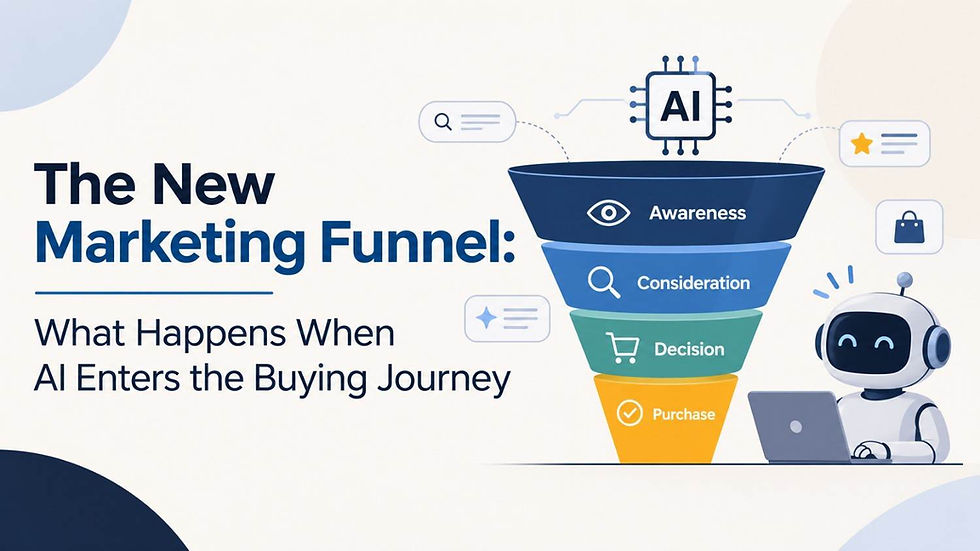
Fourth, the economics documented by Adobe suggest the new channel is not merely larger but qualitatively different: more deeply engaged, increasingly convertible, and arriving later in the funnel than historically assumed for referral traffic. This implies that content and measurement strategies built for a single click-through moment may need to be rebuilt around a multi-step journey in which an AI-generated answer, rather than a search results page, is the primary point of first contact.

Comments