Why Being Visible on Google Is No Longer Enough for Brands
Industry & Competitive Context
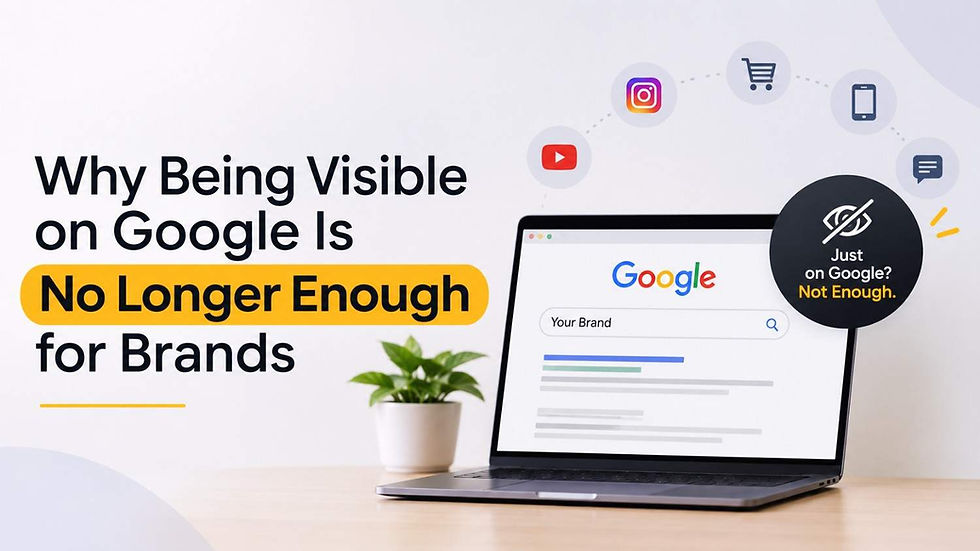
For roughly two decades, digital marketing strategy was built on a dependable premise: if a brand could rank highly on Google’s search results page, it would capture attention, traffic, and ultimately revenue. Search engine optimization (SEO) and paid search advertising grew into the two largest disciplines of performance marketing precisely because Google controlled the primary gateway through which consumers discovered products, services, and information online. Visibility on Google was treated as a proxy for brand discoverability itself.
This premise began to weaken with the introduction of AI-generated answers directly inside the search results page. Google rolled out “AI Overviews” AI-generated summaries that appear above traditional organic search listings to users in the United States starting in May 2024, later expanding the feature to more markets. The practical effect of this format is that a growing share of search queries can now be answered directly on the results page itself, without the user needing to click through to any website.
Industry analysts flagged the scale of this shift early. In a press release dated February 19, 2024, the research and advisory firm Gartner forecast that traditional search engine volume would fall by 25% by 2026, attributing the decline to the growing adoption of AI chatbots and other virtual agents as alternative answer sources to conventional search. This forecast was widely covered across trade and business media and is frequently cited in marketing-industry discussions of the shift away from link-based search toward answer-based search.
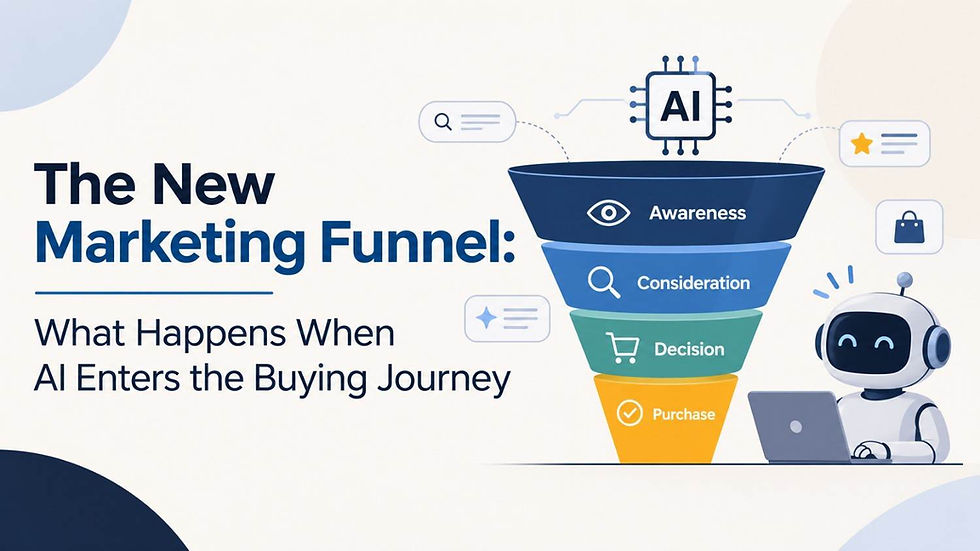
The competitive context, therefore, is one in which the search engine itself is evolving from a directory of links into an answer engine. For brands, this changes the nature of the competition: the objective is no longer simply to rank for a keyword, but to be the source an AI system chooses to cite, summarize, or recommend when a consumer asks a question whether that question is typed into Google, asked of an AI chatbot, or asked inside a voice assistant.
Brand Situation Prior to the Shift
Across the publishing and content industries, which depend heavily on search-referred traffic for advertising revenue, the effects of this shift became publicly visible through disclosed business outcomes rather than abstract commentary. The most clearly documented example is Chegg, the publicly listed education-technology company, whose core business model relies on students finding its homework-help and study content through organic search.
Chegg’s leadership stated in its public investor communications, including its quarterly earnings disclosures reported in early 2025, that traffic originating from Google search had declined and that the company attributed part of this decline to the way Google’s AI Overviews were surfacing answers directly on the search results page, reducing the need for users to click through to Chegg’s own site. This was not a speculative claim made by outside commentators it was a position the company itself took in its own public disclosures and subsequently in formal legal action.
In February 2025, Chegg filed a lawsuit against Google, alleging that AI Overviews had unlawfully used its content to generate answers on the search results page, thereby reducing demand for Chegg’s original content and causing measurable harm to its traffic and revenue. The filing was widely reported by trade publications covering the search and legal industries. This case is significant for a marketing case study precisely because it converts what might otherwise be treated as an industry trend into a documented, company-specific business event: a publicly listed company stating, on the record, that Google visibility was no longer translating into the business outcomes it once did, even though its underlying content continued to be referenced and used.
For brands more broadly, publicly available commentary from search-industry trade press throughout 2024 and 2025 described a parallel phenomenon often referred to as the “zero-click search,” in which a growing proportion of Google queries are resolved without any click to an external website. While exact figures vary by source and methodology, the directional finding that answer-format search results reduce click-through to the underlying websites that provided the information has been reported consistently enough across independent outlets to be treated as an established feature of the current search landscape, rather than a one-off or speculative claim.
Strategic Objective
The strategic question facing brands in this environment is not how to rank higher on a search results page, but how to ensure the brand is represented accurately, favorably, and prominently within the AI-generated answers, summaries, and recommendations that increasingly mediate consumer discovery across Google’s AI Overviews, independent AI chatbots, and voice-based assistants. This has given rise to a new marketing discipline, generally referred to in trade and marketing-industry literature as Generative Engine Optimization (GEO) or Answer Engine Optimization (AEO), which sits alongside rather than replaces traditional SEO.
The objective for a brand pursuing this strategy is to be cited as a trustworthy source by AI systems, to appear within AI-generated summaries where relevant queries are asked, and to maintain direct relationships with consumers (through owned channels such as email lists, apps, and communities) that do not depend entirely on being discovered through any single intermediary, whether that intermediary is a search engine or an AI assistant.
Campaign Architecture & Execution
What is publicly documented, instead, are the structural responses industry participants have taken in reaction to the shift described above.
Chegg’s documented response, as stated in its own public disclosures, included legal action against Google and a public statement that it was evaluating “strategic alternatives” for its business, reflecting a view that organic search could no longer be relied upon as the primary channel for user acquisition. This is a verified strategic pivot, even though it is a defensive and legal response rather than a conventional marketing campaign.
Separately, trade publications covering the search and publishing industries have reported that publishers and brands have increasingly diversified their traffic acquisition strategies to reduce dependence on Google search referrals, including greater investment in direct audience relationships, newsletter subscriptions, and presence on AI chatbot platforms. However, specific, company-attributed execution details (media mix, budget allocation, creative strategy) for these diversification efforts are not uniformly disclosed in public sources, and this case study does not assert figures that have not been verified.
Positioning & Consumer Insight
The underlying consumer insight driving this shift is straightforward and well documented in industry reporting: consumers increasingly prefer to receive a direct answer rather than a list of links to evaluate themselves. This preference is what Google’s own product decision to prioritize AI Overviews on its results page reflects, and it is the same preference that has driven adoption of standalone AI chatbot products for search-like queries.
For brands, the resulting positioning challenge is that being “the best answer” to a consumer’s underlying question has become more strategically important than being “the top link.” A brand’s content, data, and expertise now need to be structured and credible enough that an AI system which synthesizes information from many sources chooses to represent that brand accurately within its answer, rather than omitting it or attributing its expertise to a generic or competing source.
Media & Channel Strategy
Publicly available, verifiable detail on channel allocation specific to a named brand’s generative-engine strategy is limited. What can be stated on the basis of public record is that Google itself has continued to expand AI Overviews as a core product feature across more markets and query types following its May 2024 U.S. launch, which trade press has reported as reshaping the channel landscape search marketers must now plan around. Beyond this platform-level fact, this case study does not assert specific media mix percentages or channel budget splits for any named brand, as no verified public source for such figures was identified.
Business & Brand Outcomes
The clearest documented business outcome in this space is Chegg’s: a publicly listed company whose own investor disclosures and subsequent legal filing attribute a material decline in search-referred traffic and associated revenue impact to the architecture of Google’s AI-powered search results. The company’s decision to pursue litigation, and to publicly state it was considering strategic alternatives for its business, are both matters of public record arising directly from this dynamic.
Strategic Implications
The Chegg case, read alongside Gartner’s 2024 forecast of a structural decline in traditional search volume, illustrates a broader strategic implication for brand marketers: Google ranking position, long treated as a reliable proxy for market visibility, is becoming a less complete measure of discoverability. A brand can maintain strong organic search rankings and still experience declining traffic and revenue if the search results page itself increasingly satisfies the user’s query without requiring a click to the underlying source.
This implies that marketing strategy needs to evaluate visibility across a wider set of surfaces than the search results page alone including whether a brand is cited within AI-generated answers, how a brand’s content is structured for machine readability and citation, and how dependent a brand’s growth model is on any single discovery channel. It also implies a governance and legal dimension to marketing strategy that did not previously exist at this scale: as Chegg’s lawsuit demonstrates, brands whose content is used to generate AI answers without a corresponding traffic benefit may increasingly treat this as a commercial and legal issue, not merely a marketing optimization problem.
For brand leaders, the strategic takeaway is that “being visible on Google,” in the traditional ranking sense, is necessary but no longer sufficient. The more durable strategic asset is a brand’s ability to be recognized, cited, and trusted as a source of expertise across an expanding set of AI-mediated discovery surfaces, combined with owned-channel relationships that do not depend entirely on any single platform’s architecture.


Comments