Vaseline: The Healing Project — An MBA Case Study in Purpose-Led Brand Revitalization
- 3 days ago
- 9 min read
Industry & Competitive Context
Vaseline Jelly, owned by Unilever, competes in the global skin care and personal care category, an industry characterized by high household penetration, low differentiation among commodity moisturizing products, and increasing consumer shift toward brands with functional and emotional relevance. Vaseline is a skincare brand owned by Unilever, with its lead campaign agency being BBH New York and contributing agency PHD, operating primarily in the skin care and sun protection industries, with media channels spanning sales promotion, television, and websites/microsites.
Vaseline is described as the iconic skin healer, trusted across generations and present in more than 1.5 billion households globally, indicating a category position built on longevity and trust rather than novelty. Within the broader mass skincare and first-aid-adjacent category, competitors have historically included other petroleum-jelly and healing-balm brands; more recently, in 2025, market data referenced Aquaphor as a direct competitor tracked against Vaseline's market share performance where Vaseline gained 177 basis points of market share between April and July 2025 while competitor Aquaphor fell nearly 300 basis points over the same period.
Brand Situation Prior to Campaign
By the mid-2010s, Vaseline faced a classic legacy-brand challenge: high awareness and trust, but declining relevance and use. As the original skin healer, Vaseline products had been a trusted staple in American households for 140 years, but by 2014 their healing power was being taken for granted, and the brand was fighting slumping sales. After 140 years on the bathroom shelf, American households had forgotten just how powerful the healing power of Vaseline could be to heal skin, and the brand's task was to find a compelling demonstration of this healing power to catapult the brand back to relevance.
This describes a brand suffering from erosion of perceived functional differentiation despite strong heritage a situation common among long-established FMCG brands that risk being perceived, in the words of one campaign credit, as an "oldie." Millennials were increasingly switching to other skincare products instead of Vaseline Petroleum Jelly, viewing Vaseline as an oldie, which made it essential for the brand to attract millennial customers through a social mission.
Strategic Objective
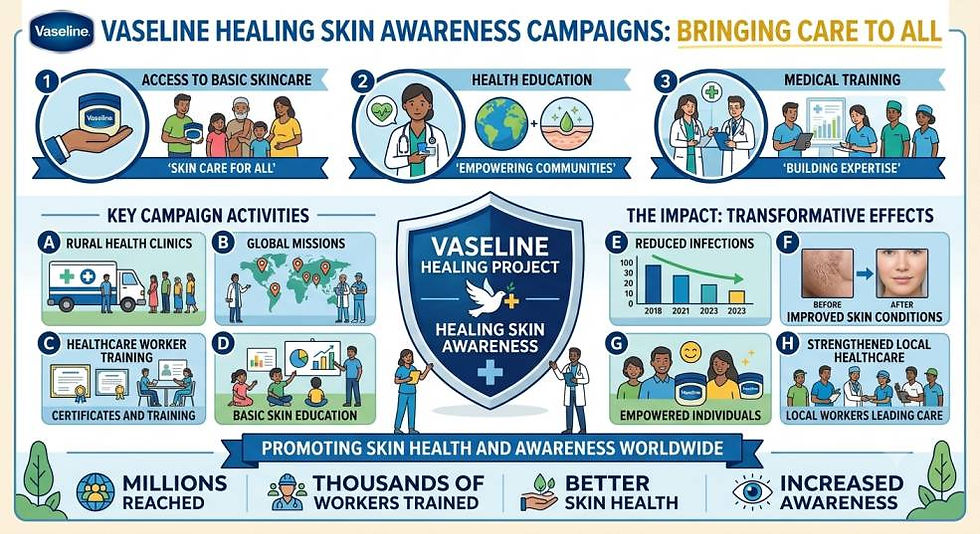
Unilever's stated objective was to convert a generic functional product benefit skin healing into a demonstrable, scaled social good that would restore brand salience and business performance. Unilever, through its Vaseline brand, launched The Vaseline Healing Project, an aid effort with Direct Relief, to provide dermatological care, Vaseline Jelly, and medical supplies to help heal the skin of people affected by poverty or emergencies around the world.
The initiative was explicitly built as a long-term brand-purpose platform rather than a single campaign burst. Unilever states its mission is to help three million people per year access dermatological care and education by 2030, and that through the Vaseline Healing Project it provides extra training to health professionals, dermatological treatment, and Vaseline products and medical supplies to help heal the skin of people affected by poverty or emergencies around the world.
Campaign Architecture & Execution
Origins and partnership structure. The Vaseline Healing Project is an aid effort in partnership with Direct Relief, providing dermatological care, Vaseline Jelly, and medical supplies needed to help heal the skin of people affected by poverty or emergencies around the world.Since its founding in 2015, the Vaseline Healing Project has reached 30 million people worldwide, and the brand states an ambition to help 33 million people heal, protect, and care for their skin through access to education, care, and donated products. Direct Relief is described as a humanitarian aid organization active in all 50 U.S. states and more than 80 countries, with a mission to improve the health and lives of people affected by poverty or emergencies, without regard to politics, religion, or ability to pay; Vaseline has partnered with Direct Relief since 2015 to provide products, education, and access to skin health care.
Geographic scale. The Vaseline Healing Project was launched in 2015 and, as of 2020, operated in over 81 countries.
Consumer-facing mechanics. The campaign combined cause-marketing purchase mechanics, participatory digital tools, and traditional film/content production. Through the promotion "Buy one help to heal one," Vaseline promised to donate USD 0.02 and one jar of Vaseline Petroleum Jelly to Direct Relief for every jar sold, as announced in 2017. Limited-edition package designs were also created that allowed customers to scan a QR code to learn the personal story of a person who benefited from the program, and customers could visit the project's official page to donate relief kits directly to people in need.Advertising, content, and social posts directed audiences to a "kit builder" tool where people could participate by adding needed supplies to a Direct Relief aid kit.
Product line extension. Vaseline created the Skin Care Station product line, consisting of Vaseline intensive care and petroleum jelly, which is donated to refugees worldwide through Direct Relief's global network.
Medical mission component. Beyond product donation, the program funded clinical expertise deployment. Vaseline sponsors dermatologists to visit remote villages that lack professional medical staff or nearby hospitals, and provides funding to invite leading dermatologists to deliver training and seminars to local medics.
Creative production and agency credits. The campaign's advertising agency was BBH New York, with Creative Chairman John Patroulis, Chief Creative Officer Ari Weiss, and Executive Creative Director Laura Fegley; the production company was Radical Media, directed by Michael Lawrence. The flagship "The Healing Project" film campaign was published in the United States in January 2016, created for the Vaseline brand by agency BBH, and categorized within the health industry.The campaign's contributing agency for media was PHD, and the disclosed campaign budget band was 10 to 20 million (currency/period as stated in the WARC case listing).
Public relations amplification. Edelman was engaged as a partner agency on The Vaseline Healing Project. A notable amplification element involved actress Viola Davis. Campaign materials reference "The Vaseline Healing Project & Viola Davis Help Heal Skin Worldwide" as part of the program's public communications.
Later evolution — "Vaseline Verified" (2024–2025). The brand's purpose-led platform was later complemented by a separate, distinct social-listening and creator-economy initiative. Vaseline Verified was built around the insight that users and creators had rediscovered Vaseline through viral "hacks" on TikTok and Instagram, generating billions of views, some of which veered into unsafe territory such as using Vaseline for teeth whitening, eyelash growth, ingestion, or as a sexual lubricant the latter use reported by one in five users and flagged as a risk for condom breakage. Vaseline Verified was built as a Social R&D ecosystem that fact-checks social hacks, and creators who received "Vaseline Verified" status could link their verified hacks directly to product purchase through their own personal TikTok Shops via the TikTok affiliate program, earning a share of each sale. This later initiative is a distinct campaign from the original Healing Project and is included here only to the extent it is publicly documented, since it forms part of Vaseline's continuous brand-relevance strategy in the same "healing" territory.
Positioning & Consumer Insight
The strategic insight underpinning the Healing Project was that Vaseline's core functional claim skin healing could be repositioned from a private, incremental household benefit into a visible, large-scale act of humanitarian good, thereby making an old product culturally and emotionally relevant again. The brand's task was explicitly framed as finding a compelling demonstration of Vaseline's healing power in order to catapult the brand back to relevance after 140 years on the household shelf.
A secondary, audience-specific insight emerged from the brand's later purpose work: in conversations with the Vaseline team, it was learned that Black women over-index as Vaseline consumers, which opened the door for Vaseline to address racial inequities in skin healthcare as a potent direction with strong brand connections, leading to identification of key partners and a consumer-facing launch campaign about equity in skin healthcare.
The consumer insight behind Vaseline Verified centered on correcting misinformation while co-opting cultural momentum rather than fighting it. Backed by over a century of science, Vaseline positioned itself as having a responsibility to step into the hack conversation credibly and in a platform-native way, rather than simply issuing warnings.
Media & Channel Strategy
The Healing Project's disclosed channel mix combined broadcast, owned digital, and retail/sales promotion.
For Vaseline Verified, the channel strategy was social-platform-native and creator-led. The initiative operated primarily on TikTok and Instagram, the platforms on which the underlying "hack" culture originated. The program integrated directly with the TikTok affiliate program and individual creators' TikTok Shops as a social commerce mechanism.
Business & Brand Outcomes
The Healing Project — reach and recognition. The Vaseline Healing Project is documented as having helped 1.8 million people globally and having "ignited a business turnaround" for the brand. By 2025, Unilever's own Vaseline website stated the Healing Project had reached 30 million people worldwide since its 2015 founding, with an ambition to reach 33 million.
Awards recognition. The Vaseline Healing Project ("#wewillheal") won a Silver Effie in the Personal Care category in 2017 and was a finalist in the Positive Change category. A separate published source corroborates that the effort was recognized with a 2017 Effie Award in the Personal Care category.
Vaseline Verified — quantified business results. This later, separate initiative reported specific, publicly disclosed performance metrics through award-submission case studies and trade press. Vaseline Verified's reported results include +1293% growth in brand mentions, +43% e-commerce sales growth, +70% year-over-year growth for Petroleum Jelly, and +18% Underlying Sales Growth (USG) for the 2025 fiscal year. Additional disclosed business impact figures include +13.9% retail sales growth in the UK and +11.7% in South Africa over a one-month period, +43% underlying sales growth across e-commerce channels, and a +177 basis point market share gain between April and July 2025, compared to a nearly 300 basis point decline for competitor Aquaphor over the same period. In a Marketing Dive interview, a Unilever/Vaseline executive stated there were real, quantifiable results tied to the initiative: a 43% uplift in sales, over 136 million views, and positive consumer sentiment of 87%. Trade-press engagement data cited an engagement rate of 27% for the campaign compared to TikTok's stated 4% benchmark.
Broader brand trajectory. Marketing Dive reported that Unilever executives attribute the Vaseline skincare brand's 11% compound annual growth over the preceding four years (as of the November 2025 report) to strong marketing and product innovation, and separately noted that Vaseline is a billion-dollar brand for Unilever. The same report noted a Vaseline collaboration with reality television personality Amanda Batula sold out in 12 hours.
Strategic Implications
The Vaseline case illustrates a recurring strategic playbook for legacy FMCG brands facing relevance erosion: converting an under-communicated functional heritage claim into a scaled, partnership-based social mission that generates earned media, industry recognition, and based on the metrics disclosed years later around Vaseline Verified measurable commercial uplift. The sequencing evident from the public record is notable: the Healing Project (2015 onward) rebuilt narrative relevance and won effectiveness recognition (2017 Effie), while the brand's continued reach expansion was still being reported by Unilever as of 2025. Separately, Vaseline Verified (2024–2025) represents a distinct but thematically consistent strategic move using real-time social listening to convert unsanctioned, sometimes risky consumer behavior (viral "hacks") into a sanctioned, monetized, creator-economy growth channel via social commerce integration with TikTok Shops.
A limitation for any adopter of this playbook, based strictly on the public record, is that granular financial attribution (e.g., how much of Unilever's reported 11% four-year CAGR for Vaseline is attributable to the Healing Project versus Vaseline Verified versus other product innovation) is not separately disclosed. The case therefore supports directional conclusions about the effectiveness of purpose-led and culture-led brand strategy, but does not support precise ROI modeling, since Unilever has not published campaign-specific financial attribution in the sources reviewed.
Discussion Questions
The Vaseline Healing Project reframed a commodity functional benefit ("skin healing") as a scaled humanitarian mission delivered through a third-party NGO partner (Direct Relief). What organizational and governance conditions are necessary for a corporate brand to credibly co-own a humanitarian mission without appearing to instrumentalize the cause for commercial gain?
Vaseline Verified addressed consumer-generated, platform-native "hacks" some beneficial, some risky by validating rather than suppressing them. Under what conditions should a brand embrace unsanctioned consumer behavior as a growth lever versus intervening to correct or restrict it, particularly when safety risks (as disclosed regarding unsafe usage occasions) are involved?
Comparing the Healing Project (2015–ongoing) and Vaseline Verified (2024–2025), both initiatives are described as restoring "relevance" to a 140+ year old brand, yet through very different mechanisms CSR/cause marketing versus social commerce/creator economy. What does this sequencing suggest about how legacy brands should evolve their relevance strategy across different marketing eras?
The publicly disclosed results for Vaseline Verified (e.g., +1293% brand mentions, +43% e-commerce sales, +177bps market share gain) are drawn primarily from award-submission case studies rather than audited financial disclosures. What are the methodological limitations of using award-submission metrics as evidence of causal marketing effectiveness, and what additional data would an MBA analyst want before recommending budget reallocation based on these figures?
The Healing Project's insight that "Black women over-index as Vaseline consumers" led to a consumer-facing campaign on equity in skin healthcare. What are the strategic risks and opportunities when a brand builds purpose-driven positioning around a demographic insight about its existing core consumer base, as opposed to targeting a new or aspirational audience?

Comments